
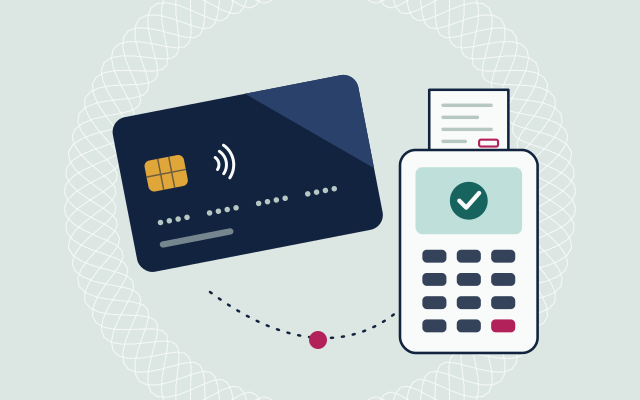
The five parties
Every card payment involves the same cast, whatever the brand on the card.
- The cardholder is you.
- The merchant is the shop, with its terminal or online checkout.
- The acquirer is the merchant's bank. It collects card payments on the shop's behalf.
- The card network is Visa, Mastercard or RuPay. It connects thousands of banks so that any card works at any shop.
- The issuer is your bank, the one that gave you the card and holds your account or credit line.
- CardYou
- TerminalThe shop
- AcquirerShop's bank
- NetworkVisa, RuPay
- IssuerYour bank
The network never holds your money and the acquirer never sees your balance. Each party does one job, and that separation is what makes the system scale.
Authorisation: the two seconds you see
When you tap, the chip in your card creates a one-time code for that payment. The terminal wraps the card details, the amount and that code into a request and sends it to the acquirer. The acquirer forwards it to the network, and the network reads the first six to eight digits of the card number to identify the issuer and route the request there.
The issuer makes the decision. It checks that the card is active, that the one-time code is genuine, that the balance or credit limit covers the amount, and that the payment does not look like fraud. Its answer travels back along the same path, and the terminal prints the result.
An approval at this stage is a promise, not a transfer. The issuer sets the amount aside so you cannot spend it twice, but the shop has not been paid yet.
What is inside the message
Most card systems speak a format called ISO 8583. A message has a four-digit type and a set of numbered fields. A few of the important ones:
| Part | Example | Meaning |
|---|---|---|
| Message type | 0100 | A request to authorise a payment. The reply is 0110. |
| Field 2 | Card number | Identifies the card and, through its first digits, the issuer. |
| Field 4 | 000000050000 | The amount in the smallest unit, here ₹500.00 in paise. |
| Field 39 | 00 | The response code. 00 means approved. |
Why payments fail
Field 39 is where a decline is explained. If you work in payments support or testing, you will see these daily.
| Code | Meaning | Usual cause |
|---|---|---|
| 05 | Do not honour | The issuer declined without giving a specific reason, often a risk rule. |
| 51 | Insufficient funds | The balance or credit limit does not cover the amount. |
| 54 | Expired card | The expiry date has passed or was entered wrongly. |
| 91 | Issuer unavailable | The issuer's system did not respond in time. |
Clearing and settlement: when money moves
At the end of the day the merchant's approved payments are sent for clearing. The network works out how much each issuer owes each acquirer, then nets it off, so banks exchange one figure instead of millions of small transfers. Settlement is the actual movement of that net amount between banks. The shop usually receives its money by the next working day.
This is why a refund takes days even though the purchase took seconds. The purchase needed only a promise. The refund has to travel back through clearing and settlement.
Who earns what
The shop does not receive the full amount. It pays a fee, often called the merchant discount rate, and that fee is shared three ways:
- Interchange goes to the issuer and is usually the largest share. It pays for the credit risk, fraud cover and rewards.
- The network fee goes to the card network for running the rails.
- The acquirer's margin is what remains for the merchant's bank and its payment partners.
- Issuer, as interchange
- Card network
- Acquirer

Prakash Nayak
Software architect and engineering leader with 25+ years in software, nearly ten of them leading payments architecture at Fiserv. Book a mentoring session or write to me.