
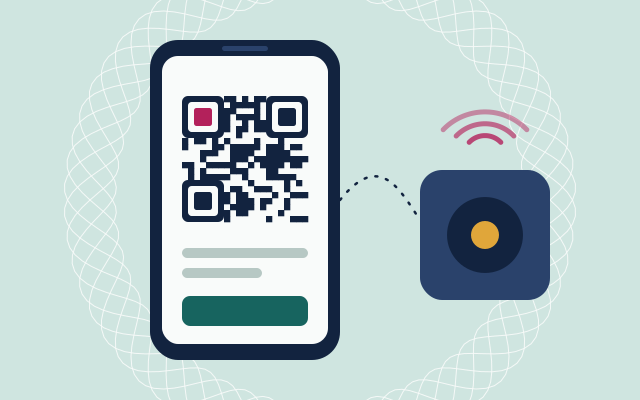
Who is involved
UPI is run by NPCI, the National Payments Corporation of India. A single payment touches five parties:
- Your app, such as a bank app or a third-party app. In UPI terms it is your payment service provider.
- Your bank, which holds your account and debits it.
- NPCI, the central switch that routes every message.
- The receiver's app provider, which knows which bank account sits behind the receiver's UPI ID.
- The receiver's bank, which credits the money.
A UPI ID is an address, not an account
An ID such as name@bank is a pointer. It hides the account number and IFSC behind something easy to share. The part after the @ tells NPCI which provider to ask for the real account details. This is why you can change the bank account behind a UPI ID without telling anyone who pays you.
The steps of a payment
- You scan the shop's QR code. It contains the shop's UPI ID and sometimes the amount.
- You enter your UPI PIN. Your app sends the payment request to NPCI.
- NPCI asks the receiver's provider to translate the UPI ID into a bank account.
- NPCI asks your bank to debit your account. Your bank verifies the PIN, checks the balance and debits.
- NPCI asks the receiver's bank to credit the shop's account.
- Confirmations flow back to both apps, and the soundbox speaks.
All of this normally completes within a few seconds, at any hour of any day.
Where your PIN goes
The PIN screen looks like part of your app, but it is drawn by a secure component supplied by NPCI. The PIN is encrypted on your phone the moment you type it, and only your own bank can check it. The app provider cannot read it. This design is what allows third-party apps to offer UPI without ever handling your bank credentials.
Why a payment shows as pending
UPI is a chain of requests and replies with strict time limits. Most stuck payments come from one situation: your bank has debited your account, but the reply from the receiver's bank did not arrive in time. Nobody in the chain can be sure whether the credit happened.
The system resolves this afterwards. The banks compare records with NPCI, and if the credit never happened the debit is reversed automatically. That reconciliation is why the money comes back after some time instead of instantly.
If you are testing or supporting a UPI product, the timeout cases deserve most of your attention. The successful path is simple. The value of a payments engineer shows in how the system behaves when a reply goes missing.
Instant for you, later for the banks
The shop sees the money immediately, but the banks themselves do not send each payment one by one. NPCI totals what each bank owes the others and the banks settle those net amounts in batches several times a day. The instant credit you see is your bank trusting that settlement will follow.
How this differs from a card
A card payment is a pull: the shop asks for money and your bank agrees. A typical UPI payment is a push: you instruct your own bank to send money. That is one reason UPI needs no card number, no terminal chip reader, and no separate authorisation and clearing stages.

Prakash Nayak
Software architect and engineering leader with 25+ years in software, nearly ten of them leading payments architecture at Fiserv. Book a mentoring session or write to me.